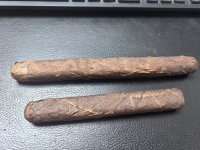
First of many: cigar from local leaf

Luacino

Member
Joined
Jan 30, 2026
Messages
23
Points
13
Location
China
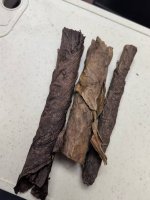
I finally bought some tools and domestic tobacco leaves and rolled my first batch of fuma. I encountered a few problems:

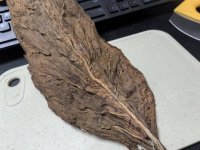
1. The local tobacco growers use different varieties than the Cuban ones. They use some kind of knee-high, eight-leaf plant, use stalk cut, and don't distinguish between ligero and viso. This has left me unsure how to make the blend.

2. The leaves they brought back were bundled in bunches of dozens, each leaf rolled up like a stick and very dry, like dried fish. I need to find a way to restore their moisture.

This month, I hope to roll them into proper cigars and then try adding some Nightcap as fillers.

Any suggestions are welcome.
微信图片_20260206151853_122_226.jpg微信图片_20260206151852_121_226.jpg
 

Luacino

Member
Joined
Jan 30, 2026
Messages
23
Points
13
Location
China
The one on the left is the worst; the taste is very mixed and a bit foul.
The one in the middle seems to be some kind of ligero, with nutty and woody spice notes.
The one on the right is so-so; usable but not great.

Overall, they all have a strong nitrogen and ammonia smell; perhaps I can work a blend out of it.

Can this performance be improved through secondary fermentation/aging? The growers told me their pilon fermentation lasts about half a month to a month, then they dry and pack it.
For me, the fermentation is neither sufficient nor even.

How can I improve this? Thank you.
 

GreenDragon

Moderator
Joined
Jan 18, 2018
Messages
2,147
Points
113
Location
Charlotte, NC
A strong ammonia odor tells me that the fermentation process did not complete. Indeed, South American growers typically pilon cure for 3-6 months in the tropical heat and humidity. Bob has kindly provided links to DIY kilns that will allow you to complete the fermentation process in a timely manner.
 

Luacino

Member
Joined
Jan 30, 2026
Messages
23
Points
13
Location
China
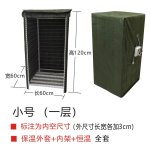
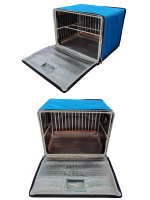
Are we looking for a temperature and humidity controlled fermentation container?

I found two different models on Taobao, from 7~70 USD. They have PID heating mat, but for humidity, I might need a Boveda or an electronic humidifier. I'm not sure if they'll be sufficient.

Do you have any suggestions on fermentation parameters? I might be moving in mid-March, and currently I'm using a tobacco humidifier in a bag, which I leave on the floor. We have underfloor heating here.O1CN01UqbmCO26wYuObVXPR_!!691917726.png_.jpgO1CN01fkhvwK1DgG65WC8Wn_!!58040245.jpg
 

Luacino

Member
Joined
Jan 30, 2026
Messages
23
Points
13
Location
China
A strong ammonia odor tells me that the fermentation process did not complete. Indeed, South American growers typically pilon cure for 3-6 months in the tropical heat and humidity. Bob has kindly provided links to DIY kilns that will allow you to complete the fermentation process in a timely manner.
I'm not sure if secondary fermentation is feasible, and whether I need to add extra yeast or enzymes. But I should give it a try.

I'm also a bit unsure whether the odor is from oxidation/anaerobic fermentation/ammonia. Next year, I'll definitely have them send the harvest directly to me; I'll ferment it myself at home.
 

deluxestogie

Administrator
Staff member
Joined
May 25, 2011
Messages
26,057
Points
113
Location
near Blacksburg, VA
The term, "fermentation", is confusing with regard to air-cured tobacco. In this context, "fermentation" refers to the natural (aging) oxidation of carbohydrates and albuminous proteins contained within the leaf lamina. [Oxidation of proteins yields the ammonia.] This is caused by intrinsic enzymes (oxidase, peroxidase) within the leaf. No added organisms are needed.

With time (measured in months to years), and the presence of oxygen and available moisture, tobacco continues to age in this manner. A tobacco kiln simply accelerates that enzymatic process by increasing the temperature. The primary intrinsic enzyme, oxidase, denatures (is destroyed) at 149°F. The secondary (slower acting) intrinsic enzyme, peroxidase, denatures at about 191°F.

Bob
 

deluxestogie

Administrator
Staff member
Joined
May 25, 2011
Messages
26,057
Points
113
Location
near Blacksburg, VA
So even after it's dried out, it can still regain moisture and continue fermenting, right?
Different processes:
  1. color-curing from green (live), freshly harvested leaf, to brown
  2. aging or fermenting leaf that has already color-cured
You are correct for leaf that has already completed color-curing after harvest. It is different from green leaf that is in the process of air-curing (called color-curing). If a green leaf dries out while it is still green, it aborts the air-curing process, and never cures properly.

Bob
 

Luacino

Member
Joined
Jan 30, 2026
Messages
23
Points
13
Location
China
aging or fermenting leaf that has already color-cured
So, regarding aging, will the dried, brittle leaves continue to age after rehydration? Will any of the self-fermenting substances lose their activity?

Thank you for your patient explanation.
 

Luacino

Member
Joined
Jan 30, 2026
Messages
23
Points
13
Location
China
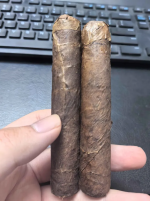
The two "dog rockets" I rolled actually looked like poop, literally.

As for the materials, I couldn't find anything better for the wrapper; the tobacco leaves here are all thin, long, and have even larger stems. I should try to improve the cap.

IMG_20260209_174559.png
 

StoneCarver

Bureau for Paranormal Research and Defense
Joined
Aug 26, 2025
Messages
176
Points
63
Location
Winston-Salem,NC
Those cigars you rolled are definitely some respectable attempts; you should be proud. If the tobacco has a strong ammonia odor particularly when smoked, it may not be "aged/fermented/kilned". There's a lot of information here about how to do the process yourself; there are a couple ways you can do it. Most of us build our own kiln to age/ferment our tobacco because its cheap and easy. That said, AI and google translate may not be so accurate; so ask questions if something doesn't seem to make sense. I know personally how inaccurate these computer translators can be.

Misting the tobacco with water using a hand-mister is all you need to do to rehydrate the tobacco for rolling into cigars; its standard practice in fact. To rehydrate for aging/fermentation/kilning, it really depends on the process you decide upon but a crock pot filled with water is usually sufficient for providing heat and humidity during the kilning process. Of course, you can get as high tech as you want for providing heat and humidity but most people here prefer to keep it cheap and cheerful.
 
Last edited:

Luacino

Member
Joined
Jan 30, 2026
Messages
23
Points
13
Location
China
There's a lot of information here about how to do the process yourself; there are a couple ways you can do it. Most of us build our own kiln to age/ferment our tobacco because its cheap and easy.
Thank you for your reply. My English is generally sufficient. Many people on the forum have tried kilning, but there doesn't seem to be a standard procedure.

I won't be smoking any of these cigars for now, as the raw materials are of very poor quality. I'm treating it as a relaxing and educational exercise. I hope to roll a structurally sound robusto by the end of the month.

In March, I estimate I can find other, better suppliers to roll cigars with recipes and try secondary fermentation for the first time. But honestly, for personal smoking, buying commercial cigars is more convenient. My main rotation is aladino and padron, plus some trendy single cigars from friends.
 

Luacino

Member
Joined
Jan 30, 2026
Messages
23
Points
13
Location
China
Today I tried rolling my first Churchill and Toro, experimented with box pressing; it looks somewhat promising.
Overall, this batch of leaves was awful: uneven fermentation, thin and long leaves, thick stems, and lack of resilience, making them prone to cracking.
I'll switch suppliers next time.

d3247a7a7fe2feddca0535c5cd035615.jpg55f6125d15ae658b0570ba0ad4117c53.jpg
 

Luacino

Member
Joined
Jan 30, 2026
Messages
23
Points
13
Location
China
Smoked one, didnt dry propperly.
The flavor is pretty good in the middle, rough at start.

Question:
1.why lots of cigars is rough at the start? cause it was mostly leave tip in the first thrid?
2.how did wrapper and binder influence the overall tastes? should a blend starting with filler or binder/wrapper?
3.someone torned apart a padron 1926.9m, the binder is kinda a thin greenish elastic one, and the filler is one leaf of viso wrapping around the bunch of one seco/volado and one and a half of ligero.
cant tell the varieties of those leaves, seems like the are using a half leaf bunching method also lieberman machine, overall a very industry and efficient setup.
aint one and a half of ligero to much? and ligero needs years of aging to be blending like this? I wanna try.

1773837785608.png
 

StoneCarver

Bureau for Paranormal Research and Defense
Joined
Aug 26, 2025
Messages
176
Points
63
Location
Winston-Salem,NC
Sometimes cigars are rough at the start because of how they are lit. What I do is hold the foot(?) of the cigar over a flame until it begins to smolder. I never inhale the flame into the cigar because that causes the tobacco in the cigar to scorch and can create rough flavors, harsh smoke. its been my practice to get the cigar lit by subjecting it to as little heat and flame as I can manage. The idea is to gently light the cigar. At least that's my practice in order to minimize rough flavors at the start. Also, once the cigar is smoking, I don't inhale through it right away. Instead, I blow some air through it. That expels any smoke from lighting the cigar that may deposit rough flavors in the cigar. Hope this makes sense. Its easier to demonstrate rather that explain with words.
 
Top