
Pasiasiainen
Well-Known Member
HI everyone!
I thought I’d write some (oh this became loooong post) of my first year experiences on growing and curing tobacco in small scale in Finland. I have gotten so many good advices from here, so I thought I’d like to contribute if someone who is trying to grow tobacco in Finland/same kind of climate, finds this useful. Lots to read, so load up your pipe and grab a cup of good coffee.
There must be better ways to do than how I did it, and I am also pointing out my mistakes here, but I managed to get decent results - at least it currently seems that way. Let’s see what the end product will eventually be after kilning, pressing, casing and all that fun stuff ahead. I am trying to make pipe tobacco. I stumbled upon FTT a bit late in the growing season, and felt that it was too late to start my own real grow blog, so this is more like my all-in-one-post-grow-experience-log-kind-of-thingy.
For better readability I have separated this post to sections with short descriptions, experiences and key takeaways:
Finland: Area and Climate for Growing
Seeds and Seed Starting
Soil Preparation
Hardening and Transplanting
Growing and Plant Care
Harvest and Curing
Up next
I tried to add links to products that I have successfully used, because at least for me it was very time consuming (but part of the fun also) to find the stuff that was needed. Unfortunately for you english speaking majority, most of the sites I have linked to are only in Finnish as the shops are mainly in Finland.


Key takeaways


Key takeaways


Key takeaways


Air Curing


Key takeaways
// Pasi
I thought I’d write some (oh this became loooong post) of my first year experiences on growing and curing tobacco in small scale in Finland. I have gotten so many good advices from here, so I thought I’d like to contribute if someone who is trying to grow tobacco in Finland/same kind of climate, finds this useful. Lots to read, so load up your pipe and grab a cup of good coffee.
There must be better ways to do than how I did it, and I am also pointing out my mistakes here, but I managed to get decent results - at least it currently seems that way. Let’s see what the end product will eventually be after kilning, pressing, casing and all that fun stuff ahead. I am trying to make pipe tobacco. I stumbled upon FTT a bit late in the growing season, and felt that it was too late to start my own real grow blog, so this is more like my all-in-one-post-grow-experience-log-kind-of-thingy.
For better readability I have separated this post to sections with short descriptions, experiences and key takeaways:
Finland: Area and Climate for Growing
Seeds and Seed Starting
Soil Preparation
Hardening and Transplanting
Growing and Plant Care
Harvest and Curing
Up next
I tried to add links to products that I have successfully used, because at least for me it was very time consuming (but part of the fun also) to find the stuff that was needed. Unfortunately for you english speaking majority, most of the sites I have linked to are only in Finnish as the shops are mainly in Finland.
Finland: Area and Climate for Growing
- I live in City of Lappeenranta, South-East Finland in Lakelands, next to Lake Saimaa.
- Climate here is typically a bit warmer than rest of the Finland at this latitude as we lay on the edge of continental climate zone. Summers are getting hotter. During our typical shortish summer, June-August, we get up to 18 hours of sunlight per day. Temperatures vary between 15-30 C.
- Growing season seems to be long enough for tobacco, but weather gets colder fast after mid-September, and that makes air curing for 6-8 weeks a challenge.
Key takeaways
- Fair amount of sun available in Southern Finland, seems suitable for tobacco growing
- Growing season is long enough if you get to transplant in the first days of June or before. Keep an eye on Finnish frost forecast at Foreca site, so you know when it is safe to transplant: https://www.foreca.fi/halla
- Curing outside or in unheated shed is not a good option as temperature gets too cold. You probably need heated space for curing.
Seeds and Seed Starting
- I bought my seeds, Virginia Gold and Burley 21, from Finnish online seed store https://www.suomensiemenpankki.fi/collections/tupakat.
- I planted the seeds 22. February, which was too early. My plants grew 40-50 cm tall before I could transplant them, and all the South windows in our house were filled with big tobacco plants. (=wife+kids not very happy).
- I started 108 seedlings with a goal of 18 strong plants. I planted the seeds in Biolan potting soil https://www.biolan.fi/tuotteet/puutarhatuotteet/kasvualustat/biolan-kylvo-ja-taimimulta to “mini greenhouse” with 36 pots and plastic cover. I put 3 seeds to each pot. Keeping the soil moist all the time with a spray bottle.
- After seedlings had two pairs of leaves, I started giving Tomato and Chili fertilizer in light dozes now and then. https://www.hankkija.fi/Piha_ja_puu...kekkila-tomaatti-chililannoite-200-g-2035590/
- Selected 36 best plants.
- I grew the seedlings on my kitchen window facing South. I assume there was not enough light as the days are quite short in Feb-March. Seedlings grew with long, thin wobbly stems that had to be supported.
- After selecting the best 22 plants i transferred those to bigger 9x9cm seedling pots, and built these kind of rope shelves for the plants so you can fit many pots to same window https://www.etsy.com/de-en/listing/1029239267 . I had my plastic growing pots inside plastic boxes so I could water them from below. I assumed that it would improve root growth.
Key takeaways
- When selecting what to grow, gather first enough information - in my case what kind of tobacco you will need for pipe blends - so you will have more variety in hand when blending. I should have grown also some Oriental tobacco, for example.
- It could be a good idea to have growth lamps to get stronger stems on your seedlings
- Seed starting was easy and 100% of my seeds germinated
- Good time to plant the seeds with only sunlight exposure would be around 25th of March to get about 20 cm tall plants to be transplanted in the beginning of June.
Soil preparation
- I prepared a small, 2 x 4 m area to my backyard for my planned 18 plants. It turned out to be too small, but I managed.
- Area was bordered by hedges and big spruces to get some protection from winds. Cost of the wind protection was that I got only 7-8 hours of direct sunlight per day.
- I tilled, cleaned the soil from roots and weed, and fertilized the soil in the beginning of April. Added 2 wheelbarells of leaf compost, general spring fertilizer https://www.kekkila.fi/tuotteet/kevatlannoite-plus/, 3 bags of soil https://www.biolan.fi/tuotteet/biolan-musta-multa.html and also some chicken manure-based fertilizer. https://kauppa.biolan.fi/tuote/biolan-kasvimaalannoite-55-l/ I think I used too much fertilizers, as I had trouble with leaves not ripening at the end of the season.
- Keep the amount of fertilizers moderate or your plants won’t mature/ripen in time. If using store-bought soil, remember that those are already fertilized.
Hardening and Transplanting
Hardening- I started hardening 2 weeks before transplanting, but weather got so cold again that I eventually hardened the plants only for a week at my porch in the shade. Starting from 10 min / day, and doubling the time every day.
- I only exposed the plants to sun for few hours in total, and that was not enough. I watered the plants normally.
- I transplanted 18 quite flimsy-stemmed, wobbly plants on 24th of May, 3 months (!) after sowing the seeds.
- I supported about half of the plants stems with loosely tied wide papertape attached to 60 cm sticks
- Weather was cloudy for first three days, but when the sun came out, 25% of the leaves got sunburned. After worrying for the first two weeks and looking at those wilted, partially sunburned poor plants, they started to strenghten and grow at a good pace.
Key takeaways
- Harden for longer time (at least more than a week), and remember to gradually expose to sun. After reading from FTT, also water deprivation before transplanting seems a good idea. https://fairtradetobacco.com/threads/water-deprivation-before-transplanting.667/
- Leave enough space (at least 50 cm) between plants and keep rows at least 80 cm apart so it is easier to sucker and maintain the plants. It is difficult to dive inside tobacco jungle and you easily break leaves doing that.
- It could be good idea to protect new plants from harsh spring sun with a garden fleece or similar. https://www.puuilo.fi/farmari-hallaharso-3-2x9-4m
- Don’t worry if the plants look horrible for the first days, they seem to recover nicely.
- If your plants have flimsy stems, the plants will still eventually grow quite nicely and form a strong stem - just remember to support them with sticks. Place the sticks so that they will not hit the leaves in wind.
Growing and Plant Care
Fertilizing and watering- After my plants recovered from transplanting and got used to the sun everything went mostly ok.
- For the first month I fertilized with 800g of chicken manure-based fertilizer (Biolan kasvimaalannoite), couple of doses of Tomato-Chili fertilizer from Kekkilä to 30 liters of water.
- Last dose of fertilizers was a month from transplanting when I sprinkled about 0,5 litres of that same “Biolan kasvimaanlannoite” around stems. I think I overshoot fertilizing here also, keeping in mind that my soil was quite fertilized from the start.
- We had a lot of rains in the first 1,5 months of the summer, so I rarely watered my plants other than in the first two weeks. I think my plants had grown good roots that even when there was 3 weeks of very hot and dry weather in July, they grew very nicely.
- At the end of June I started to notice some yellow spots on some of the leaves. I then sprayed 0,03% Epsom salt water to the leaves with a spray bottle and sprinkled about 0,5 litres of Birch ash close to stems, thinking that maybe the reason for yellowing was magnesium and potassium deprivation. After a week yellowing stopped and new leaves came out with very strong green color.
- Strong winds were coming so I protected my plants with a garden fleece attached to wooden poles. They survived. One leaf lost.
- I topped all plants between 5th July to 17th July. That would make 42-54 days from transplanting. I was very anxious to top the plants, so when ever I saw a crows foot appearing, I immediatelly snapped the bud off.
- I don’t know if my plants grew unusually furious amount of suckers, but I had to sucker them every 3 days from the topping until harvest.
- My plants were growing too close to each other, that suckering was difficult. I also missed one plant completely as it was so hard to see, that it ended up growing to a weird sucker-frankenstein of a plant.
- Take it easy on fertilizing and make sure there are also good balance with other nutrients other than NPK.
- Watch for storms and hard winds and have something at hand to protect your plants quickly.
- Be prepared to sucker a lot
Harvest and Curing
Harvest- My plants grew to about 170 cm tall. I ended up with about 12-16 good leaves per plant. Lost some to sunburns, some to winds, some were hit by falling twigs and cones.
- I started priming Burley 21 (mainly lugs plus handful of lower leafs) around 60 days after transplanting to test air curing setups. First batch of Virginia Gold was harvested and flue cured 83 days after transplant.
- I found it very difficult to spot the early signs of leaf maturity especially in Virginia, as I was trying to pick leaves at the same maturity level. After 3 flue curing batches I kinda got hang of it and my flue curing results started to be more consistent.
Air Curing
- I tested with lugs and first primings how Burley would start air curing in different environments. I tried outside under the eaves, inside my unheated warehouse, inside my warehouse in a plastic greenhouse (https://www.motonet.fi/tuote/4living-kasvihuone-50-x-108-x-45-cm-musta?product=85-03335) , with and without air circulation. Not good results.
- As the daytime temperatures were surprisingly low at the end of August-Mid september (9-15 C) and nighttime temps started to drop to close to 5 C, I noticed that leaves did not cure. I had lot of green spots and uneven color.
- I decided to move my plastic greenhouse to my boiler room, where the temperature stays between 27-30 C, and cure the main crop there. I also found old humidifier from local recycling center and put that inside the greenhouse. That keeps the relative humidity within 65-85% as it is connected to timer that is on and off in 45 min intervals. I installed vintage tiny computer fan in the tent and put an old oscillating room fan outside the tent to blow in some dry air in 30 min intervals. I cut a small hatch to the top of the greenhouse to release extra humidity. Not perfect setup, but now after 4 weeks the leaves look amazing and I haven’t spotted any mold.
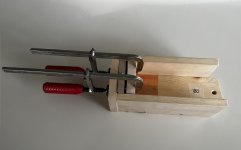
- I built a small flue-curing chamber/kiln - specs and pictures here https://fairtradetobacco.com/thread...experience-any-advice-for-the-next-run.13273/
- I ran 5 batches. As I only had 8 plants of Virginia Gold, and wanted to fill the chamber as much as I could for each run, I always ended up picking a few leaves that were not mature enough. It is hard to find enough leaves on same maturity level when you have so few plants.
- About 80 % of the leaves cured very nicely, and most of the leaves that had green cast I cured in the sun for a few days and that made the color even yellow. For last batches this did not work anymore as sun was already very low and rainy, cloudy cold fall had arrived.
- To me, most difficult ones to cure were the top leaves. I think they got a bit too ripe on the plant, yellowed to my surprise very fast and eventually cured too brown. So you really have to watch the leaves closely and move on from yellowing stage when the signs are there. And not wait at all.
Key takeaways
- Air curing in Finland is difficult outside or in unheated warehouse, as weather gets too cold so quickly and (Burley) leaves don’t cure.
- Finnish recycling centers are goldmines when looking for parts and gadgets for curing setups
- Building your own custom flue-cure chamber is fun, but it is not free (mine costed about 300€)
Wrap-up
If someone from Finland / Nordics is wondering if you can grow and process tobacco in our not-so-optimal conditions, it is possible, but requires some effort and equipment. That said, it’s a very fun hobby that I highly recommend for anyone looking for a bit of a challenge.
Up next
Now that all my leaves are either flue-cured and stored, still curing or aging in my kiln, I am starting to prepare myself for Cavendish cooking, pressing, casing and all that fun stuff waiting ahead. But that will be another post...// Pasi
Last edited: