What the science says about casing.

hayfield311

Member
Joined
Feb 13, 2025
Messages
14
Points
13
Location
saudi
Hello friends. In this thread I'll share some infos on casing from multiple scientific papers and tobacco experts since there's a lot of misinformation floating around in tobacco community about casing and humectants such as PG and VG. Most of the text is copy pasted from the source.


On casing
Casings usually are applied by spraying or dipping a portion of the leaf or the entire leaf. They are composed of water, sugars (fruit extracts and honey), humectants and flavor (cocoa and licorice).
Licorice and Cooca are used in Burley tobaccos. Honey is used in Virginia.

Source


How much casing?

  • It’s up to the blender, but 15–20% of the dry tobacco weight is a common number. Add whatever u want to a 100ml of water (because its hard to work with a 10ml solution) then use only 15 or 20% of it and spray it to a 100g of tobacco.
    Source
    (You can go as low as 5% if u want more of the tobacco flavor)
  • Burley leaf has the ability to absorb up to 25% of its weight of added material
    Source

On Citric Acid

Citric Acid was found to remove the undesirable sharpness and pungency and render the tobacco smooth and agreeable like a tobacco of much higher quality.

Read more here
2% could be too much, this paper suggests using from 0.5% to 1%


On Sugars

  • Sugar was introduced into US blended cigarettes in 1913 as a result of a decline in chewing tobacco manufacturing, utilizing essentially the same tobacco-casing formulation. The resulting taste was instantly accepted by the American public.
  • The types and amounts of various sugars added to tobacco blends will vary from manufacturer to manufacturer and from blend to blend.
  • Percent total sugars among US brands covers a range of about 8-12% by weight although it is not known how much is added sugar nor in what proportion the sugars are distributed between bright and burley tobaccos in the blend
  • Two important sweetening agents in cigarette manufacture in the United States are maple sugar and honey, which are both used - in saucing or casing of cigarette tobaccos because of the particular aroma they impart to fresh cigarettes and cigarette smoke .

Source


On the role of humectants in tobacco


  • Glycerol, Propylene Glycol, and Sorbitol are examples of polyol compounds (traditional humectants) that have been widely employed in tobacco production for moisture adsorption and retention.
    Source
  • PG allows the dissolving of many flavoring substances, has low volatility, and provides good protection of the most volatile flavor compounds.
    Source
    (This means PG will help the flavors stay bound to the tobacco)
  • Propylene glycol appears to have a specific inhibitory effect against bacteria and most molds; the addition of 10% w/v propylene glycol was found to inhibit the growth of these organisms.
    Source
    (It could effect the good microbes)

How much humectants (PG or VG or both) to add?
  • Typical total humectants concentration ranging from 1% to 5% of the dry leaf weight
    Source

(2% is the sweet spot for me, so you want to add 2-5ml of PG to your 15-20 ml casing solution to a 100g of dry leaves)


The dangers of Propylene Glycol
  • Most of propylene glycol is transferred to smoke at levels that are high enough to irritate the eyes and airways.
  • It produces harmful substances when it is burnt like propylene oxide.
  • Propylene oxide has been classed as a possible cancer-causing.

Source
 

StoneCarver

Bureau for Paranormal Research and Defense
Joined
Aug 26, 2025
Messages
202
Points
63
Location
Winston-Salem,NC
I really appreciate this information. I'm not so interested in using casing to "add flavor". However, I am interested in using casing to alter the chemistry of the smoke such as using citric acid. So, any info on the chemistry effects of casing ingredients is something I'm always interested in learning about. I like my tobacco a bit on the dry side so I have no interest in humectants.
 

Juxtaposer-

Well-Known Member
Joined
Jun 11, 2024
Messages
185
Points
93
Location
Las Vegas
I can attest that licorice root while working wonders on air cured tobacco (including cigar leaf) does not do much for flue cured. It acts more like an anti bitter agent rather than a sweetener.
I almost always have near 2% citric acid in all my casings. This does not mean that the tobacco ends up as being 2% citric acid. This is just the dilution ratio.
I do not bother measuring and create unique casings to taste as in I actually taste the casing. More or less works fine unless you really want to hit maximum levels.
when testing a new ingredient I will normally put what I think of as too much to see if the particular ingredient has any unwanted effects which may be found especially in the second half of a bowl.
I have recently become interested in artificial sweeteners not wanting the extra goop that sugars add. A simple packet of equal has done wonders although aspartame is not stable and will eventually break down and loose its sweetness which has me looking at Neotame, a derivative of aspartame that is much more stable. Will report more soon.
I don’t plan on ever using PG even though it has many qualities that make it ideal in tobacco I think the subtle taste it adds ruins tobacco and it holds way to much moisture in my opinion.
 

Bamabaccy8a

Active Member
Joined
Mar 31, 2026
Messages
32
Points
18
Location
North Alabama
Since pressure pot steaming my tobacco earlier this week, i popped the lids yesterday , noticed a subtle difference in aroma . You fellows that are more experienced in casing your own pipe tobacco...would you be comfortable sharing a basic recipe for , say a vanilla , bourbon , chocolate flavoring. Citric acid in every casing? What form and where do you source your ingredients. Hoping its a simple grocery store baking / canning aisle item.
 

burge

Well-Known Member
Joined
Apr 11, 2014
Messages
1,691
Points
113
Location
Alberta
I don't use casing but have tons of honey. My guess would be a tablespoon to a liter of water
 

hayfield311

Member
Joined
Feb 13, 2025
Messages
14
Points
13
Location
saudi
Since pressure pot steaming my tobacco earlier this week, i popped the lids yesterday , noticed a subtle difference in aroma . You fellows that are more experienced in casing your own pipe tobacco...would you be comfortable sharing a basic recipe for , say a vanilla , bourbon , chocolate flavoring. Citric acid in every casing? What form and where do you source your ingredients. Hoping its a simple grocery store baking / canning aisle item.

You can get everything from your local store but if you want extra flavor like the commercial blends, OliveNation is the best.


hayfield311

Member
Joined
Feb 13, 2025
Messages
14
Points
13
Location
saudi
I never realized how much PG makes my pipe gurgle till I started smoking tobacco that doesn't have PG. I agree it holds way too much moisture.

Most blends, even the ones that we regard as very high quality, have some PG on them. I think the only one that doesn't have it is Tabac De La Semois :LOL:
 

Juxtaposer-

Well-Known Member
Joined
Jun 11, 2024
Messages
185
Points
93
Location
Las Vegas
I really appreciate this information. I'm not so interested in using casing to "add flavor". However, I am interested in using casing to alter the chemistry of the smoke such as using citric acid. So, any info on the chemistry effects of casing ingredients is something I'm always interested in learning about. I like my tobacco a bit on the dry side so I have no interest in humectants.
The difference between casing and topping are highlighted by this comment.
 

Bamabaccy8a

Active Member
Joined
Mar 31, 2026
Messages
32
Points
18
Location
North Alabama
You can get everything from your local store but if you want extra flavor like the commercial blends, OliveNation is the best.

Im also a homebrewer. I think i still have some cacao nibs left from a chocolate stout brew.
I also have moonshine based homemade vanilla . Might add some to a jar of leaf .
 

ShiniKoroshi

Dept. of Shenanigans
Joined
Nov 18, 2024
Messages
441
Points
93
Location
Florida
You can get everything from your local store but if you want extra flavor like the commercial blends, OliveNation is the best.

Chocolate Extract, but it isn't.
Screenshot (2649).png
Chocolate (from concentrated what?)
Vanilla Extract (notice the specifics)

Not saying it would or would not be any good on tobacco (but Im sure its quite tasty in milk).
Its just one example of how speed-running though information can lead to unintended consequences.
Considering the vast array of variables we are trying to control for the perfect smoke, attention to detail pays huge dividends.

As mentioned above, I have my own Cacao extraction going. But still, variables remain though vastly minimized.
KGB-5-7-26c.jpg
 

hayfield311

Member
Joined
Feb 13, 2025
Messages
14
Points
13
Location
saudi
Chocolate Extract, but it isn't.
View attachment 59513
Chocolate (from concentrated what?)
Vanilla Extract (notice the specifics)

Not saying it would or would not be any good on tobacco (but Im sure its quite tasty in milk).
Its just one example of how speed-running though information can lead to unintended consequences.
Considering the vast array of variables we are trying to control for the perfect smoke, attention to detail pays huge dividends.

As mentioned above, I have my own Cacao extraction going. But still, variables remain though vastly minimized.
View attachment 59514

Its quite tasty in deserts. Theres a hint of earthiness in it but not as complex as dark chocolate. I like that its PG and oil free.
 

StoneCarver

Bureau for Paranormal Research and Defense
Joined
Aug 26, 2025
Messages
202
Points
63
Location
Winston-Salem,NC
ShiniKoroshi,
In my state, Everclear is 150proof, which means like 25% water. This is by state law because political teetotalers decided state law was required to reduce the numbers of college students needing their stomachs pumped; I'm sure it didn't work at all but the politicians probably feel smug about themselves and that's what's important. But there is a way to draw that water out by using mol sieves. I use Everclear for making varnish from bee propolis and water isn't good for that for a number of reasons. I don't know if water will affect your application but here's a work around in case it does.


Bamabaccy8a

Active Member
Joined
Mar 31, 2026
Messages
32
Points
18
Location
North Alabama
Chocolate Extract, but it isn't.
View attachment 59513
Chocolate (from concentrated what?)
Vanilla Extract (notice the specifics)

Not saying it would or would not be any good on tobacco (but Im sure its quite tasty in milk).
Its just one example of how speed-running though information can lead to unintended consequences.
Considering the vast array of variables we are trying to control for the perfect smoke, attention to detail pays huge dividends.

As mentioned above, I have my own Cacao extraction going. But still, variables remain though vastly minimized.
View attachment 59514
That cacao everclear one got my attention. the cacao i have , its been a while since i had it out, honestly i thought i remembered having nibs ... i mixed up a little cacao powder and some ...umm homemade corn likker ? And added stripped leaf to that concoction ,made sure evenly distributed, packed in a jar, ran it through the pressure pot an hour . I will open that once i get a new press box made and see how that turns out.
 

ShiniKoroshi

Dept. of Shenanigans
Joined
Nov 18, 2024
Messages
441
Points
93
Location
Florida
That cacao everclear one got my attention. the cacao i have , its been a while since i had it out, honestly i thought i remembered having nibs ... i mixed up a little cacao powder and some ...umm homemade corn likker ? And added stripped leaf to that concoction ,made sure evenly distributed, packed in a jar, ran it through the pressure pot an hour . I will open that once i get a new press box made and see how that turns out.
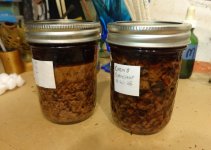
The cacao powder might be better since it should have already been pressed removing most of the lipids. That's the mid layer in my extraction though its more pronounced in the left jar since I ground up the already "lightly crushed" nibs on the right. Im cautious it will be too much if used as is after straining. We will see.
 

ShiniKoroshi

Dept. of Shenanigans
Joined
Nov 18, 2024
Messages
441
Points
93
Location
Florida
ShiniKoroshi,
In my state, Everclear is 150proof, which means like 25% water. This is by state law because political teetotalers decided state law was required to reduce the numbers of college students needing their stomachs pumped; I'm sure it didn't work at all but the politicians probably feel smug about themselves and that's what's important. But there is a way to draw that water out by using mol sieves. I use Everclear for making varnish from bee propolis and water isn't good for that for a number of reasons. I don't know if water will affect your application but here's a work around in case it does.

Cacao nib extraction can be done with 80 proof, it just goes faster with 150 proof.

I usually use turpentine to cut resins and copal is a long-standing traditional Danish varnish. Heavier terpenes such as lemon oil can be used and odorless spirits is always handy for dilution. My wood projects usually get linseed/stand oil mixed with resin or an alkyd cut with turpentine.

Molecular sieve? I didn't see any static sieves for liquids listed so this would be a monumental effort to setup not to mention prohibitively expensive. I did a lot of researching concerning molecular sieves in relation to oxygen concentrators. These were complex enough given that the sieve material works pretty simply. For the effort I would just build a still and make some moonshine, which is totally legal now. :cool:
 
Last edited:

Bamabaccy8a

Active Member
Joined
Mar 31, 2026
Messages
32
Points
18
Location
North Alabama
Cacao nib extraction can be done with 80 proof, it just goes faster with 150 proof.

I usually use turpentine to cut resins and copal is a long-standing traditional Danish varnish. Heavier terpenes such as lemon oil can be used and odorless spirits is always handy for dilution. My wood projects usually get linseed/stand oil mixed with resin or an alkyd cut with turpentine.

Molecular sieve? I didn't see any static sieves for liquids listed so this would be a monumental effort to setup not to mention prohibitively expensive. I did a lot of researching concerning molecular sieves in relation to oxygen concentrators. These were complex enough given that the sieve material works pretty simply. For the effort I would just build a still and make some moonshine, which is totally legal now. :cool:
Not totally legal . I live in Alabama, its illegal to even own a still. The feds legalized moonshine but as far as i know, at this states level...its not . They keep dangling the carrot of legal weed here, they allowed limited permits to growers but sat on that for 3 yrs trying to work out sales ( re: how to tax it , corporate banking , and prescription ...) then what to do about 2A bc we went constitutional carry couple years ago. These people still cry for wanting a state lottery . They see residents going up to TN for it and the money leaving the state . The old bible bible belters holding tight on dry counties, and weed, things they could make money on, they just want to make it too difficult . But on the other side of that coin , they want to be able to frivolously spend money they dont have to gamble in a rigged system .
Sorry for that . I know politics is a no no in here but its reality everywhere else and fairly pertinent to the topic at hand.
 

Bamabaccy8a

Active Member
Joined
Mar 31, 2026
Messages
32
Points
18
Location
North Alabama
Hello friends. In this thread I'll share some infos on casing from multiple scientific papers and tobacco experts since there's a lot of misinformation floating around in tobacco community about casing and humectants such as PG and VG. Most of the text is copy pasted from the source.


On casing
Casings usually are applied by spraying or dipping a portion of the leaf or the entire leaf. They are composed of water, sugars (fruit extracts and honey), humectants and flavor (cocoa and licorice).
Licorice and Cooca are used in Burley tobaccos. Honey is used in Virginia.

Source


How much casing?

  • It’s up to the blender, but 15–20% of the dry tobacco weight is a common number. Add whatever u want to a 100ml of water (because its hard to work with a 10ml solution) then use only 15 or 20% of it and spray it to a 100g of tobacco.
    Source
    (You can go as low as 5% if u want more of the tobacco flavor)
  • Burley leaf has the ability to absorb up to 25% of its weight of added material
    Source

On Citric Acid

Citric Acid was found to remove the undesirable sharpness and pungency and render the tobacco smooth and agreeable like a tobacco of much higher quality.

Read more here
2% could be too much, this paper suggests using from 0.5% to 1%


On Sugars

  • Sugar was introduced into US blended cigarettes in 1913 as a result of a decline in chewing tobacco manufacturing, utilizing essentially the same tobacco-casing formulation. The resulting taste was instantly accepted by the American public.
  • The types and amounts of various sugars added to tobacco blends will vary from manufacturer to manufacturer and from blend to blend.
  • Percent total sugars among US brands covers a range of about 8-12% by weight although it is not known how much is added sugar nor in what proportion the sugars are distributed between bright and burley tobaccos in the blend
  • Two important sweetening agents in cigarette manufacture in the United States are maple sugar and honey, which are both used - in saucing or casing of cigarette tobaccos because of the particular aroma they impart to fresh cigarettes and cigarette smoke .

Source


On the role of humectants in tobacco


  • Glycerol, Propylene Glycol, and Sorbitol are examples of polyol compounds (traditional humectants) that have been widely employed in tobacco production for moisture adsorption and retention.
    Source
  • PG allows the dissolving of many flavoring substances, has low volatility, and provides good protection of the most volatile flavor compounds.
    Source
    (This means PG will help the flavors stay bound to the tobacco)
  • Propylene glycol appears to have a specific inhibitory effect against bacteria and most molds; the addition of 10% w/v propylene glycol was found to inhibit the growth of these organisms.
    Source
    (It could effect the good microbes)

How much humectants (PG or VG or both) to add?
  • Typical total humectants concentration ranging from 1% to 5% of the dry leaf weight
    Source

(2% is the sweet spot for me, so you want to add 2-5ml of PG to your 15-20 ml casing solution to a 100g of dry leaves)


The dangers of Propylene Glycol
  • Most of propylene glycol is transferred to smoke at levels that are high enough to irritate the eyes and airways.
  • It produces harmful substances when it is burnt like propylene oxide.
  • Propylene oxide has been classed as a possible cancer-causing.

Source
I just had a pm with Deluxestogie.. i picked up a couple ibc totes 2 days ago from a local Ag feed additive production company . Contents formerly propylene glycol, kosher . I drained 7.5 gallons of clean clear pure PG from both totes. Now, what do i do with all of it?
 
Top