Reading Lamps and Smoking Jackets

deluxestogie

Administrator
Staff member
Joined
May 25, 2011
Messages
26,431
Points
113
Location
near Blacksburg, VA
IndiaAHistory_cover.jpg


India: a History; Revised and Updated Edition, by John Keay. (2011)

Over the decades, I've studied a fair amount of history. There are still huge gaps in my knowledge of some areas of the world. The full history of India was one of those. And, as luck would have it, I purchased this book. The author, John Keay, is my kind of author. He is skeptical. He is data driven. And he is insistent on as complete a chronology as possible. He fills in blanks with multiple possible explanations—the key word being, "possible".

Like the Bible, the ancient literature of India was not committed to writing until about 600 BC. So its "historical" narratives are derived from events passed down orally for over a half-millennium, prior to being written. We know the legends, but not much of the actual history of India until about 800 AD. What has been reconstructed has been based on such scant evidence as coins, and occasional pangyrics engraved into rock faces.

But it was the ancient intellectual blossoming of South Asia that popularized the mathmatical use of zero, a base-10 number system with decimal places, standardized measurements, as well as a solution of Pi to 3 decimal places. And they came up with an accurate calendar.

Some earlier cultures in the Middle East had explored these math innovations as well, but these cultures were nearly all wiped out by the climate collapse around 1177 BC, which affected the Mediterrainean cultures as well. But South Asia did not collapse at that time.

As with any history, we see the universal human trait of the powerful mistreating the weak. With this history in particular, we see the full flowering of European imperialism, reaching well into the mid-twentieth century.

At just over 600 pages, this is a challenging book. Who would be interested in reading it?
  • those interested specifically in the history of South Asia
  • anyone interested in the workings of emperialism
  • perhaps those interested in the vague origins of a wide array of distinct (and indistinct) religions
  • folks who wish to see the financial motivations of many (?most?) political choices
  • those curious about why aging leaders tend to squander their people's resources on building monuments
Bob
 

deluxestogie

Administrator
Staff member
Joined
May 25, 2011
Messages
26,431
Points
113
Location
near Blacksburg, VA
One other tiny tidbit that I learned from India: a history, is that the next to last British Viceroy of India (up to 1947) was Archibald Wavell. The name rang a bell. The cigar brand, La Gloria Cubana, has a stumpy, robusto-size cigar named, Wavell. Apparently, like Churchill, Wavell had a cigar named after him.

Bob
 

deluxestogie

Administrator
Staff member
Joined
May 25, 2011
Messages
26,431
Points
113
Location
near Blacksburg, VA
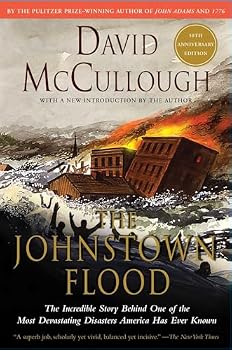
JohnstownFlood_bookCover.jpg


The Johnstown Flood, by David McCullough. (1968, 1987)

In western Pennsylvania, east of Pittsburg, a dam burst in 1889, and caused the death of 2,209 people. An entire, mountain reservoir suddenly emptied itself down a steep, narrow valley that descended 500 vertical feet over only 15 miles. It scoured both sides of the valley of all its trees and vegetation, and sent a colossal surge of debris in a roiling mass toward Johnstown. It carried with it train cars and their passengers, twisted train rails and hefty rail ties, telegraph poles, and the shattered remains of every building it struck.

"When the wireworks broke up it contributed miles and miles of barbed wire to the mountain of wreckage and water that, once past the wireworks, had only a few hundred yards to go until is struck Johnstown."

McCullough explores the long saga of neglect by America's wealthiest capitalists that led to the dam's failure. We learn of the everyday life of many of the individuals, families and businesses that were wiped out. And it was one of the most profitable news stories of the century, generating vast amounts of misinformation and sensationalism.

It is a fast read—only 268 pages of text, followed by the lists of the known dead, which are worth scanning if only to note the magnitude of the deaths of children:

Hoffman, Benjamin F., 56
Hoffman, Mrs. Mary, 43
Hoffman, Bertha, 19
Hoffman, Minnie, 16
Hoffman, Marion, 14
Hoffman, Florence, 10
Hoffman, Joseph, 8
Hoffman, Helen, 4
Hoffman, Freda, 1

Bob
 
Top