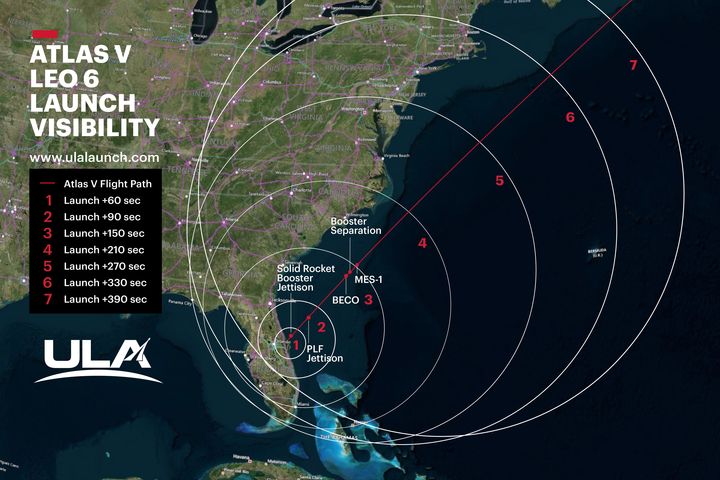
Thanks for posting about this, Bob. Although I'm a member of the local astronomy club, I don't keep up on rocket launches. We got lucky one night when we were at the club's dark sky site and saw a spacex lauch from texas. You'd think we were too far north to see it but there it was going low across the southern horizon. I'd say it was 10 to 20 degrees above the horizon. It caught my eye because it looked like this weird v shaped cloud moving across the sky. Also, just because its dark out does not mean you can't see the exhaust plume particularly after your eyes are dark adapted. So, maybe go out about 30minutes before launch. Grab something to smoke whilst dark adapting your eyes. Have some binoculars handy; 10x50 binoculars would be more than enough to do the job. You'll only get a few minutes to see it and you may need a clear, low view of the eastern horizon. After about an hour, iow the length of time for the satellites to make their first orbit, we might be able to see the trail of satelites but the website Bob linked to above doesn't seem to go that far in the information it provided.
For the spacex launch we saw, I could see the light from the engine blast with my widefield refractor at about 25x magnification.