StoneCarver 2026

TigerTom

Well-Known Member
Joined
Apr 27, 2017
Messages
338
Points
93
Location
Sacramento, Ca
I couldn't agree more! We like to sauté the buds in butter until the tips are crispy. Mmmmm....

What do you do about hornworms? I've never encountered them in Montana.

Don't forget about the root on first year plants. The wild forms may not grow as large as selected cultivars, but they're still good.
 

PvtPublic

Well-Known Member
Joined
Jan 20, 2026
Messages
71
Points
33
Location
Montana
Don't forget about the root on first year plants. The wild forms may not grow as large as selected cultivars, but they're still good.
I havent had the roots yet, but I hear they're good. How do you like to prepare them?
 

TigerTom

Well-Known Member
Joined
Apr 27, 2017
Messages
338
Points
93
Location
Sacramento, Ca
I havent had the roots yet, but I hear they're good. How do you like to prepare them?
Peel and cut them into 1" pieces, and boil with a little vinegar to keep them from turning brown. When softened, drain and saute them with some butter, salt, and pepper. Some say it tastes like oyster (hence the name" oyster plant"), but to me they have more of an artichoke flavor. After the flower stalk forms, the root become stringy.
I enjoy the seeing flowers and every year let some go to seed, so they grow all over my yard.

(For larger, more uniform roots, look for the variety called Mammoth Sandwich Island.)
 

StoneCarver

Bureau for Paranormal Research and Defense
Joined
Aug 26, 2025
Messages
312
Points
93
Location
Winston-Salem,NC
So, my basement got too humid, rH 80-85%, and much of my color cured leaves of the main crop grew mold. I think I tossed out at least half. Its not fun tossing what was very nice looking leaves. its amazing how fast the mold grows. Even after I brought the leaves upstairs to dry out, by the next day some were fuzzy with green spores when they looked fine when I brought them up. Lesson learned: the moment the leaves are sufficiently color cured, dry them out and keep them dry till they get their turn in the kiln. I want to ask this question: Does it matter if the midrib of the leaves are still green/yellow after the lamina has browned? Waiting for the midribs to turn color is what led me to keeping the leaves in my very humid basement for so long. If waiting for the mid ribs to turn color after the lamina has doesn't make much of a difference in end product quality, that would be that much less time I need before I can put the leaves in a drier environment. I don't really have any other place to color cure leaves except in my basement. The utility shed that was behind my house got stolen.

If you are wondering, I usually open the outside doors to my basement every day in the summer to let it breathe. I've been doing that for years as the basement used to flood every good rain till I got that issue fixed. Fixing the flooding reduced the humidity a great deal but its still very humid down there in summer.

This is making me very glad to have such a big sucker harvest. When its all done, my sucker crop ought to account for about 2/3 of my total harvest.
The sucker leaves aren't quite as big as the main crop leaves but there appears to be a good amount that are large enough I ought to get some wrappers. For example, amongst the Redrose, many of the sucker leaves are 18 to 24 inches long.

 

deluxestogie

Administrator
Staff member
Joined
May 25, 2011
Messages
26,440
Points
113
Location
near Blacksburg, VA
The only need for the central vein to be completely dry, prior to kilning, is if you plan to use those stems for preparing a smokeless product. If the leaf will go into storage prior to kilning, then the stem will need to be fully dried first. Once the lamina is color-cured, it no longer draws moisture (and nutrients) from the stem. But its proximity does continue to keep ambient moisture near the lamina.

Bob
 

StoneCarver

Bureau for Paranormal Research and Defense
Joined
Aug 26, 2025
Messages
312
Points
93
Location
Winston-Salem,NC
But its proximity does continue to keep ambient moisture near the lamina.
Good to know. Thanks. The mold did start at the midrib and move out into the lamina since the mid rib dried/cured last. But if I don't need to wait for the mid rib to cure after the lamina is all cured, well that means I can put the leaves in a drier place sooner to facilitate drying of the mid rib prior risk of molding. I wasn't sure how long to give the leaves to cure but now I know. I won't give them as much time next year. Fortunately, the very best leaves of my Redrose has been in the kiln for about 2 weeks now. So those were safe from molding.
 

UmbriaFarmer

Active Member
Joined
Feb 18, 2026
Messages
34
Points
18
Location
Umbria Italy
I've been priming almost daily. The Vuelta Abajo is totally primed as you can see in this photo.
With how hot and dry its been, I watered everything after I took this photo.
One of my RedRose is heavily covered in aphids. I'm thinking of taking out the whole plant even if it could mature a little longer.
I don't know what else to do about the aphids.

View attachment 60160
Can you tell me what vuelta abajo is like? What it's rolling and smoking characteristics are, strength, aroma etc are like?
 

StoneCarver

Bureau for Paranormal Research and Defense
Joined
Aug 26, 2025
Messages
312
Points
93
Location
Winston-Salem,NC
Can you tell me what vuelta abajo is like?
Bob had posted a review on vuelta abajo some years ago and that's how I learned about it. He had good things to say about it. So, far I've only grown it. Maybe next year I can tell you what smoking it is like. Its my understanding that its a common cigar variety grown in Cuba and is used for filler, binder and wrapper. Bob also smoked in a pipe. So, you could probably do whatever you want with it. I can tell you that mine started suckering before it flowered and the leaves matured. So I had to be diligent to keep the suckers pinched more so than the other varieties I grew. I think the biggest leaves were maybe 18 inches long. I'd definitely grow it again. Of the varieties I grew this year, only the Scantic and Jaffna I'm likely to not grow again. Scantic needed support and Jaffna leaves had a pronounced downward bend that I didn't care to deal with. However, the Jaffna leaves did get up to 3foot long. So far, I'm liking the RedRose the most. I'll try growing Nostrano del Brenta again too; I've smoked a little in my pipe and it had a rich flavor that seems like it would be good in a cigar. The leaves could get big too. However, Nostrano del Brenta struggled the most in my garden. I think it ought to be grown only after a person has a bit of experience with growing tobacco. RedRose had the best overall growth characteristics but was the most susceptible to aphids.

To deal with the excessive humidity in my basement, there's a 6"x6" chimney flue that goes down into the basement that was for an old heating system in my house. There had been a chimney fire in it which cracked several several of the ceramic flue tiles. So it can't be used for a wood stove anymore but it can be used for ventilation. I opened it all up and scrubbed it out. Put a proper chimney cap on the top. The heat of the sun shining on the chimney stack is enough to heat it up and make draw air up and out. I tested it by holding a smoldering piece of moldy tobacco at the opening and all the smoke was easily drawn into it. After 24 hrs of "ventilating", the humidity in my basement was at 75% rH. Maybe after a few days it will get lower; I hope it does. I've been needing to do something about the excessive humidity there for years and this has been a strong motivator to get my derriere off of my chairiere. Of course, if I included a fan, it would vent that much more. One step at a time with observations made at each step. Science doesn't always proceed as fast as we'd like.
 

deluxestogie

Administrator
Staff member
Joined
May 25, 2011
Messages
26,440
Points
113
Location
near Blacksburg, VA
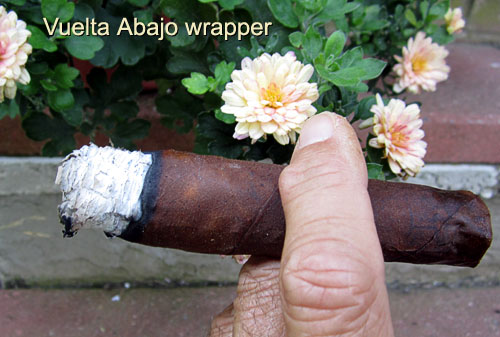
Garden20150804_1974_cigar_VueltaAbajoWrapper_500.jpg

from 2015

In Cuba's famous Vuelta Abajo, they still had not addressed Mendelian genetics by the mid 1920s. The USDA collected a number of samples of Cuban seed at that time, and labeled all of them, "Vuelta Abajo". The one "Vuelta Abajo" that several of us in the FTT forum identified as most like actual Cuban cigars was discovered by @Jitterbugdude. I never recorded its Pi number.

All subsequent cigar varieties grown or developed in the Vuelta Abajo (e.g. Corojo, Criollo, Criollo 98, Corojo 99) were ultimately derived from that mix of "Vuelta Abajo" confusion.

Bob
 

StoneCarver

Bureau for Paranormal Research and Defense
Joined
Aug 26, 2025
Messages
312
Points
93
Location
Winston-Salem,NC
That's very interesting even if it muddies the water.
I believe I got my seeds from nwtseeds.com. So, whatever those are. What I grew had a rather columnar growth habit with shorter leaves in comparison to the compact form with long leaves such as the RedRose I grew.
 
Top