The Equipment I Own

Honda Sun

Member
Joined
May 17, 2026
Messages
7
Points
13
Location
China
First off, I have a factory-made fermentation chamber. This unit has a digital display and control panel where I can set my desired temperature and humidity levels. It uses internal sensors to monitor real-time temperature and humidity, and automatically turns on the heating or humidifying systems as needed to reach and maintain those settings. I plan to use this machine as a curing kiln for processing flue-cured Virginia leaves, air-cured Burley leaves, and various other Chinese sun-cured tobaccos. I think it will let me control the condition of the leaves much more precisely.
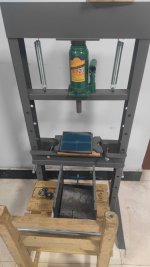
I also have a mold press made up of a set of detachable stainless steel molds, a 20-ton hydraulic jack, and a sturdy stainless steel frame. I’m really happy with how it’s built. The stainless frame can handle plenty of pressure, and the detachable molds provide excellent support while making it easy to remove the finished tobacco cakes intact afterward. The only thing I’m unsure about is whether the 20-ton jack is overkill for my 15 cm × 15 cm mold surface area. If it’s too much, I can swap it for a smaller one.
I also have two modified honey presses. They use a screw mechanism to drive a stainless steel plate downward to apply pressure. When tightened enough, they deliver very solid compression. These are sold as complete units in China, originally with perforated stainless steel buckets. I replaced the perforated ones with solid (non-perforated) stainless buckets that fit my frame and screw system perfectly. I plan to use these two units for small-scale Perique tobacco experiments.
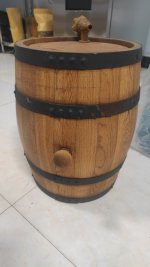
I also picked up a small oak barrel from a local winery. It’s a used wine barrel that was previously full of aging red wine. If my Perique experiments turn out well, I’d like to use this barrel to make larger batches.
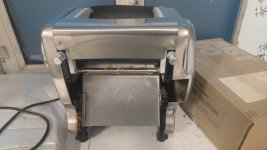
In addition, I have an electric tobacco leaf cutter. It uses a motor to drive two stainless steel rollers that evenly slice the leaves into 1 mm wide shreds. This machine will make producing my own cigarette tobacco a lot easier and more consistent.
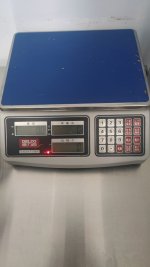
I also have various smaller tools like a 0.1 g precision digital scale, a small vacuum sealer, airtight glass jars, resealable bags, and amber dropper bottles for light protection. I won’t go into every little item.
Based on your experience, what kinds of great-tasting tobaccos do you think I can make with this setup? I’d really appreciate your suggestions.
1000030615.jpg1000030616.jpg1000030617.jpg1000030619.jpg1000030618.jpg1000030620.jpg1000030621.jpg1000030622.jpg1000030623.jpg1000030625.jpg1000030624.jpg
 

StoneCarver

Bureau for Paranormal Research and Defense
Joined
Aug 26, 2025
Messages
214
Points
93
Location
Winston-Salem,NC
That fermentation chamber is like totally wow. I am interested in hearing how it works for you. Most of us have to build something because such machines aren't easily available.

I also press honey using a screw press similar to yours. Yours should be totally adequate for pressing tobacco. I originally bought my screw press for making wine but then found its very useful for doing crush and strain honey extraction. In fact, I now use it more for honey extraction than wine. I don't produce enough honey to bother with a centrifuge and my honey bees are in Layens type hives instead of Langstroth hives. So there isnt really any centrifugal extractors that will work for Layens frames.
 

Honda Sun

Member
Joined
May 17, 2026
Messages
7
Points
13
Location
China
That fermentation chamber is like totally wow. I am interested in hearing how it works for you. Most of us have to build something because such machines aren't easily available.

I also press honey using a screw press similar to yours. Yours should be totally adequate for pressing tobacco. I originally bought my screw press for making wine but then found its very useful for doing crush and strain honey extraction. In fact, I now use it more for honey extraction than wine. I don't produce enough honey to bother with a centrifuge and my honey bees are in Layens type hives instead of Langstroth hives. So there isnt really any centrifugal extractors that will work for Layens frames.
It's already late at night here in China, and after a full day of work, I'm pretty wiped out. So I'll just give you a quick rundown on how the fermentation box has been working for me.
Overall,
I'm really impressed with it. It's super simple to operate. The electronic display and control panel make it easy to see exactly how different temperature and humidity levels affect the tobacco, which lets me run solid controlled experiments without much hassle.
That said, it does have quite a few shortcomings. I'll go into more detail tomorrow during the day in the comments below—covering its structure, how it works, the issues I've found, why those problems occur, and my plans to improve them.
 

johnny108

Well-Known Member
Joined
Feb 23, 2023
Messages
1,150
Points
113
Location
Germany
With that kind of equipment, and the right seeds, you can make almost every type of cigarette or pipe blend you want or need.
I say almost, because, if you have a bbq smoker (like those used for meats), you can then make “fire cured” tobacco, which I think is the last type of tobacco, possibly even Latakia- if you can get the right mixture of herbs and twigs.
Overall, you seem to have the most complete set of equipment I’ve ever seen!

But, what I am interested in, is the Chinese sun cured varieties you mentioned…
What varieties are they? Do you have any descriptions and/or pictures of them?

Excellent set up! I’m jealous.
 

Honda Sun

Member
Joined
May 17, 2026
Messages
7
Points
13
Location
China
That fermentation chamber is like totally wow. I am interested in hearing how it works for you. Most of us have to build something because such machines aren't easily available.

I also press honey using a screw press similar to yours. Yours should be totally adequate for pressing tobacco. I originally bought my screw press for making wine but then found its very useful for doing crush and strain honey extraction. In fact, I now use it more for honey extraction than wine. I don't produce enough honey to bother with a centrifuge and my honey bees are in Layens type hives instead of Langstroth hives. So there isnt really any centrifugal extractors that will work for Layens frames.
Hey, as we agreed yesterday, let me walk you through the structure of my fermentation box, how it works, its current limitations, and my upgrade plan.
The main components inside the unit are a temperature and humidity sensor, a circulation fan, an air heating element, a water tank with a water level float switch, and a heating tube inside the water tank.
When I set my target temperature and humidity, the sensors start monitoring the inside of the box. If the temperature is too low, the controller automatically turns on the air heating rod. If the humidity is too low, it activates the heating tube in the water tank to generate steam. The circulation fan then evenly distributes the warm air and moisture throughout the entire chamber. Once the set values are reached, both heaters shut off. The controller, sensors, and fan keep running as long as the unit is powered on. This automated system makes it really easy to maintain a stable environment with minimal manual work.
Now, here are the issues I’ve noticed: All the heating and humidifying components are located at the bottom of the box, while the temperature and humidity sensor is at the top. This means that by the time the sensor at the top detects that the target levels have been reached and turns everything off, the bottom is already too hot and too humid. Additionally, the box is made of very thin stainless steel, so its insulation is pretty poor. This causes a lot of condensation to form inside during operation. The weak insulation also makes the temperature and humidity differences between the top and bottom even worse.
So my improvement plan is to buy some extruded polystyrene (XPS) insulation boards, cut them to size, and attach them to the outside of the box. I believe this will significantly improve the overall performance and stability once it’s done.
 

Honda Sun

Member
Joined
May 17, 2026
Messages
7
Points
13
Location
China
With that kind of equipment, and the right seeds, you can make almost every type of cigarette or pipe blend you want or need.
I say almost, because, if you have a bbq smoker (like those used for meats), you can then make “fire cured” tobacco, which I think is the last type of tobacco, possibly even Latakia- if you can get the right mixture of herbs and twigs.
Overall, you seem to have the most complete set of equipment I’ve ever seen!

But, what I am interested in, is the Chinese sun cured varieties you mentioned…
What varieties are they? Do you have any descriptions and/or pictures of them?

Excellent set up! I’m jealous.
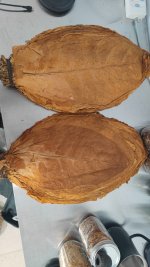
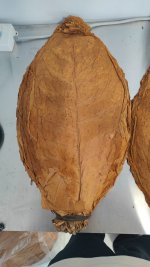
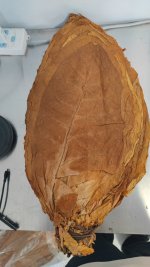
This is what I refer to as Chinese traditional tobacco. Honestly, I don’t think that name is entirely accurate, because China isn’t the native home of tobacco. Every variety currently grown in China was introduced from abroad — whether original foreign varieties, their mutations, or hybrids.
The reason I call it that is because this particular type has been cultivated for a very long time in Northeast China. Local farmers started growing it in the late Qing Dynasty, and it has continued ever since. Since it doesn’t have an official variety name, people around here just call it “Little White Flower.” I know that’s a very generic name, especially since white-flowered tobacco is pretty common. So instead, I refer to it as Chinese traditional air-cured tobacco.
This variety doesn’t grow very tall. Right now in Northeast China, we’ve just transplanted the seedlings into the field, so I can’t show you the full plants yet. Once they develop more, I’ll upload photos so everyone can see and help identify them.
The leaves on this variety are thick and quite sticky. I believe this comes from a combination of the genetics and the local fertilization methods — people here often use soybean meal as fertilizer, and in some extreme cases, they even apply soybean oil.
This tobacco has relatively high nicotine content, but the smoke is surprisingly mild and smooth. After proper air-curing and coloring, it smokes really well. If you age it for two years or more, it develops a much more complex and appealing aroma. Interestingly, when you smoke it during the hottest and most humid month of August, it has a very noticeable sweet taste on the tongue. In theory, air-cured tobacco like this has low sugar content, so it shouldn’t taste sweet. I suspect that under certain temperature and humidity conditions, the burning characteristics change, producing different chemical compounds that kind of “trick” your tongue into perceiving sweetness. I haven’t figured out the exact mechanism yet, but I plan to run a lot more experiments to get to the bottom of it.
I have some of this tobacco that was air-cured and colored back in November 2025. I’ll put the photos below for everyone to see and appraise. Thanks!1000030626.jpg1000030627.jpg1000030628.jpg
 

deluxestogie

Administrator
Staff member
Joined
May 25, 2011
Messages
26,165
Points
113
Location
near Blacksburg, VA
My initial impression of the leaf is that it is a lovely, Basma-type Oriental. But then I noticed what appear to be food canning jars in one of the photos. So I was significantly misinterpreting the size of the leaf. Could you provide a measurement of the leaf length and width?

Bob
 
Top