You may wish to investigate the question of possible interaction or interference between your different biologicals.
Bob
Good evening Sir,
I take you for a reader, so I’ll provide some links to studies I went through, in a lot of cases only read the abstract and discussion, in order for you or other members to read that might find it interesting.
Bt-kurstaki and B. bassiana used to together has been found to be synergistic and also protect against more pests. In theory, Bt stops feeding of the larva and causes it’s metabolism to crash, making the cuticle infection from Beauveria to work quicker.
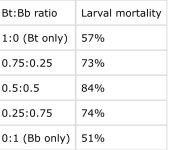 Sayed, A.M.M. and Behle, R.W. (2017) "Evaluating a dual microbial agent biopesticide with Bacillus thuringiensis var. kurstaki and Beauveria bassiana blastospores." Biocontrol Science and Technology, 27(4): 461–474. DOI: 10.1080/09583157.2017.1303662
Trichoderma and Beauveria work together, as found in a study by Batool et al. The combination killed 98% of Asian corn borer larvae vs 88% for Beauveria alone. No antagonistic or negative effects between the two were observed. Both colonised the plants well and coexisted without reducing each other's efficacy.
Batool, S. et al. (2020) "Synergistic Effect of Beauveria bassiana and Trichoderma asperellum to Induce Maize Defense against the Asian Corn Borer and Larval Immune Response." International Journal of Molecular Sciences, 21(21): 8215. DOI: 10.3390/ijms21218215
Trichoderma and Bacillus, what I intend to use for prevention of soil and leaf diseases, work together against bacterial wilt, but application should be directed at different zones. One applied to the soil, and the other as a foliar application. A follow up study found that they can interfere with each other slightly, if grown together in a lab dish, but at the very worst you might just have or the other taking over where they interfere. Planned for soil drench and foliar spray, not applied as a mix.
Zhou, Y. et al. (2021) "Synergistic Effect between Trichoderma virens and Bacillus velezensis on the Control of Tomato Bacterial Wilt Disease." Horticulturae, 7(11): 439. DOI: 10.3390/horticulturae7110439
Izquierdo-García, L.F. et al. (2024) "Synergistic interactions of Trichoderma virens and Bacillus velezensis to control tomato bacterial wilt." European Journal of Plant Pathology. DOI: 10.1007/s10658-024-02881-6
A study very relevant to what I am doing.
Aynalem et al. tested Beauveria, Metarhizium and Bt together. Applied as single products, pairs, and all three combined, against Tuta absoluta, the tomato leafminer. This is a big threat in my area for tobacco. Basically my whole insect stack in one experiment.
The combined treatments beat the individual products. So the stack should work, as long as each product is used in its own lane.
Aynalem, B. et al. (2022) "Biocontrol competence of Beauveria bassiana, Metarhizium anisopliae and Bacillus thuringiensis against tomato leaf miner, Tuta absoluta." Heliyon, 8(4)
One that I got wrong myself. I sprayed Beauveria and Metarhizium together earlier this week. Both work and interact the same and are competing with each. No harm done, apart from wasting the additional product. Will be applying as separate applications. Beauveria for the leaves and Metarhizium for the soil and stem base.
Notable interactions I have found. Double Nickel for leaf disease is a Bacillus that works by producing antifungal compounds. Beauveria and Metarhizium are fungi. Compatibility studies keep finding that Fungicides are the biggest risk to insect fungi in a spray program.
Shadmehri et al. found that every fungicide, at every concentration tested was incompatible with both Beauveria and Metarhizium. It significantly inhibits spore germination and growth. Tests were done with chemical fungicides, but an antifungal Bacillus will work in the same manner. Double Nickel and the insect fungi applied at least 5 days apart and never from the same tank. To be fair to the other side, one study did find a specific Bacillus strain compatible with Beauveria, so it is strain dependent. But without data on my exact strains, I’ll rather play it safe and not waste the money.
Shadmehri, A.D. et al. (2016) "Compatibility of entomopathogenic fungi Beauveria bassiana and Metarhizium anisopliae with some pesticides."
Khun, K.K. et al. (2021) "Compatibility of Metarhizium anisopliae and Beauveria bassiana with insecticides and fungicides used in macadamia production in Australia." Pest Management Science, 77(2): 709–718. DOI: 10.1002/ps.6069
I think to apply it simply and practically biologicals that attack the same target the same way compete. Biologicals that attack different targets in different places cooperate. Antifungals kills fungi, good and bad. And copper kills everything apply it alone.
It will be very important to log what was applied when and to make notes on actual performance.
Plants tonight after mixed Beauveria and Metarhizium application,