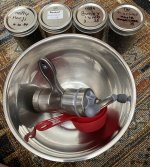
How I process my whole leaf

Juxtaposer-

Well-Known Member
Joined
Jun 11, 2024
Messages
243
Points
93
Location
Las Vegas
Any questions or discussion are welcomed. I am making things up as I go and get my ideas from forums like this. This idea came about by looking at kilning temperatures. Not having a kiln I have been trying different ways to elevate temperatures to affect tobaccos. Outside in the summer is being tried although to prevent mold the jars are vacuum sealed and without normal levels of oxygen this is not kilning but rather low temperature stoving. The lowest temperature in the oven is 175F and I have also done this. Twelve hours is all the oven will go until it would need to be reset but according to some calculations I made I would want a whole week at this temperature. Simply not practical. The idea of pre stoving at this low temperature is to affect some kind of change and then ride out the results with some aging to develop this. After this aging a stoving at higher temperatures (200F-4hrs) will be done to “lock in” the changes. Granted what I think is happening is all imaginary but it seems possible this could make some difference. Otherwise there is not much discussion out there on this type of experimentation as most will settle on traditional methods.
 

johnny108

Well-Known Member
Joined
Feb 23, 2023
Messages
1,228
Points
113
Location
Germany
What about a water bath?
I saw a YouTube channel where a guy used a sous vide cooker in a bucket of water. The tobacco was sealed in bags and submerged.
He left them there for a month or so, and came back to successfully kilned tobacco.
Aquarium water heaters may also get close to a temperature where kilning enzymes are more active. The tobacco container will have to be very well sealed, of course, and the moisture level of the leaf will need to be lower than ideal, to prevent mold.
 

Juxtaposer-

Well-Known Member
Joined
Jun 11, 2024
Messages
243
Points
93
Location
Las Vegas
What about a water bath?
I saw a YouTube channel where a guy used a sous vide cooker in a bucket of water. The tobacco was sealed in bags and submerged.
He left them there for a month or so, and came back to successfully kilned tobacco.
Aquarium water heaters may also get close to a temperature where kilning enzymes are more active. The tobacco container will have to be very well sealed, of course, and the moisture level of the leaf will need to be lower than ideal, to prevent mold.
Yes for temperature but no for oxygen. Here is the rub! Breaking down air cured tobacco to mellow for smoking requires oxygen. Elevated moisture and temperatures do help but if you include oxygen then mold will grow. The solution is to have the temperature high enough to suppress mold growth with moisture and oxygen present. A well designed kiln is perfect for this. Aging with enough oxygen at lower moisture levels also supports this breakdown. Here with oxygen the balance between moisture and temperature will suppress mold.
Flue cured tobacco is a different story. I certainly can be improved by the oxidative processes but it’s not as necessary and having most of its enzymes destroyed by the heat of its color curing not as effective. This is where an environment with no available oxygen can affect change and with a higher sugar content an anaerobic environment is where flue cured tobacco can improve dramatically. With no available oxygen moisture and heat can be applied with little concern for mold. There are ideal temperatures and moisture levels for supporting microbial activity but time can negate their importance. There are also temperatures that will destroy microbial life which is what exposure to oxygen can do as well. High enough temperature can also destroy cellular structures in tobacco which can be a good thing. There are many kitchen gadgets that can be used in various ways but I don’t like the idea of an appliance being on for months.
 

FosmicCilth

Active Member
Joined
Sep 4, 2025
Messages
25
Points
13
Location
Albuquerque, New Mexico
I made a kiln for mason jar kilning from one of these:


And added a second heating pad to put on top of the jars. I use boveda packets to hold moisture and I have had great results with 6 weeks at 122 degrees. I air out the jars to add oxygen periodically and have had no mold growth. It is very easy to determine the stage of fermentation with this method by smell as the volatiles are concentrated when you open the jar.

For air cured, I ferment them for 6 weeks, airing out as much ammonia as I can every week or two, then I let them get bone dry to drive off all ammonia before rehydrating to store. This seems to work well and takes very little space/is affordable enough to experiment with without a big commitment.

Recently I have been spraying Va and Connecticut Broadleaf with half vanilla bean-infused rum and half water before jar-kilning. So far the Broadleaf is some decadent stuff, perfectly suitable for pipe/blending, it is amazingly smokeable. I am still waiting on the Va to see how it affects that process as I prefer my virginias kilned. The rum-kilning seems to affect the pH in a desirable way for the Broadleaf.
Yes for temperature but no for oxygen. Here is the rub! Breaking down air cured tobacco to mellow for smoking requires oxygen. Elevated moisture and temperatures do help but if you include oxygen then mold will grow. The solution is to have the temperature high enough to suppress mold growth with moisture and oxygen present. A well designed kiln is perfect for this. Aging with enough oxygen at lower moisture levels also supports this breakdown. Here with oxygen the balance between moisture and temperature will suppress mold.
Flue cured tobacco is a different story. I certainly can be improved by the oxidative processes but it’s not as necessary and having most of its enzymes destroyed by the heat of its color curing not as effective. This is where an environment with no available oxygen can affect change and with a higher sugar content an anaerobic environment is where flue cured tobacco can improve dramatically. With no available oxygen moisture and heat can be applied with little concern for mold. There are ideal temperatures and moisture levels for supporting microbial activity but time can negate their importance. There are also temperatures that will destroy microbial life which is what exposure to oxygen can do as well. High enough temperature can also destroy cellular structures in tobacco which can be a good thing. There are many kitchen gadgets that can be used in various ways but I don’t like the idea of an appliance being on for months.
 
Last edited by a moderator:

UmbriaFarmer

Well-Known Member
Joined
Feb 18, 2026
Messages
152
Points
63
Location
Umbria Italy
Yes for temperature but no for oxygen. Here is the rub! Breaking down air cured tobacco to mellow for smoking requires oxygen. Elevated moisture and temperatures do help but if you include oxygen then mold will grow. The solution is to have the temperature high enough to suppress mold growth with moisture and oxygen present. A well designed kiln is perfect for this. Aging with enough oxygen at lower moisture levels also supports this breakdown. Here with oxygen the balance between moisture and temperature will suppress mold.
Flue cured tobacco is a different story. I certainly can be improved by the oxidative processes but it’s not as necessary and having most of its enzymes destroyed by the heat of its color curing not as effective. This is where an environment with no available oxygen can affect change and with a higher sugar content an anaerobic environment is where flue cured tobacco can improve dramatically. With no available oxygen moisture and heat can be applied with little concern for mold. There are ideal temperatures and moisture levels for supporting microbial activity but time can negate their importance. There are also temperatures that will destroy microbial life which is what exposure to oxygen can do as well. High enough temperature can also destroy cellular structures in tobacco which can be a good thing. There are many kitchen gadgets that can be used in various ways but I don’t like the idea of an appliance being on for months.
Actually my empirical observation re the need for oxygen differs from your statement. Although I only process cigar leaf now, I used to process a lot of bright and black tobaccos for my pipe blends and did so anaerobically with great results. I would put the leaf into very high case, roll up 10 leaves into a sausage shape and pack the sausages tightly into 4 litre glass jars with airtight lids. I packed the jars brim-full. The jars got submerged in a water tank I constructed - there was an immersion heater element with t'stat and a small circulating pump to keep temps even throughout the tank. I maintained the temp at between 45 and 50C (about 115 to 125F I think) for a month. After this treatment I'd go on and press different blends to make flake and the results were excellent. And at those temps, never a single mold issue either.
 

Juxtaposer-

Well-Known Member
Joined
Jun 11, 2024
Messages
243
Points
93
Location
Las Vegas
I am finding the air cured tobaccos that I have processed anaerobically are great. It’s just that after they have been exposed (intentionally) to air for a few days they start to develop the bitter ammonia flavors. Of course minimizing exposure to oxygen could prevent this. This ammonia sickness indicates to me that these tobaccos could be improved by oxidative processing. It’s not that these tobaccos are unusable especially in mixtures. A personal goal of mine is to have an all Burley pipe tobacco. This would require a significant amount of mellowing.
 

bbfarmky

Active Member
Joined
Sep 6, 2026
Messages
30
Points
18
Location
Lebanon, Kentucky
I am finding the air cured tobaccos that I have processed anaerobically are great. It’s just that after they have been exposed (intentionally) to air for a few days they start to develop the bitter ammonia flavors. Of course minimizing exposure to oxygen could prevent this. This ammonia sickness indicates to me that these tobaccos could be improved by oxidative processing. It’s not that these tobaccos are unusable especially in mixtures. A personal goal of mine is to have an all Burley pipe tobacco. This would require a significant amount of mellowing.
Admittedly my head is still spinning from trying to understand the intricacies and benefits of anaerobic vs aerobic aging, kilning vs flue-curing, etc...but would that ammonia not "cook off" with a little more time in one process or another?
 

UmbriaFarmer

Well-Known Member
Joined
Feb 18, 2026
Messages
152
Points
63
Location
Umbria Italy
Admittedly my head is still spinning from trying to understand the intricacies and benefits of anaerobic vs aerobic aging, kilning vs flue-curing, etc...but would that ammonia not "cook off" with a little more time in one process or another?
Well you know something? I've just finished kilning all my criollo,aerobically, 6-8 weeks, 85%rh, 50°C, 125F, and only once, for one day, have I noticed the evolution of ammonia. So either whatever the ammonia comes from, there ain't much off it in my leaf, or it's still all hiding in there somewhere....
 

FosmicCilth

Active Member
Joined
Sep 4, 2025
Messages
25
Points
13
Location
Albuquerque, New Mexico
I am finding the air cured tobaccos that I have processed anaerobically are great. It’s just that after they have been exposed (intentionally) to air for a few days they start to develop the bitter ammonia flavors. Of course minimizing exposure to oxygen could prevent this. This ammonia sickness indicates to me that these tobaccos could be improved by oxidative processing. It’s not that these tobaccos are unusable especially in mixtures. A personal goal of mine is to have an all Burley pipe tobacco. This would require a significant amount of mellowing.
I am trying to make an all burley pipe tobacco as well and I have some burley red tips that had some kind of incredible amount of ammonia in them. I had to jar kiln them twice, for a total of about 8 weeks, and keep airing it out and then dry them down. I put them in a pyrex baking tray and set it on top of my kiln to get them fully dry before rehydrating. That worked to really mellow it out to being in a smokeable form.

The same burley was also toasted without kilning and let off a cloud of ammonia when I opened the oven. It was then cased and left in a jar for about a year and it is great now.

I have also had really good results jar kilning dark air-cured and kentucky dark fired to mellow their harshness, no casing required at all.
 

Juxtaposer-

Well-Known Member
Joined
Jun 11, 2024
Messages
243
Points
93
Location
Las Vegas
I am trying to make an all burley pipe tobacco as well and I have some burley red tips that had some kind of incredible amount of ammonia in them. I had to jar kiln them twice, for a total of about 8 weeks, and keep airing it out and then dry them down. I put them in a pyrex baking tray and set it on top of my kiln to get them fully dry before rehydrating. That worked to really mellow it out to being in a smokeable form.

The same burley was also toasted without kilning and let off a cloud of ammonia when I opened the oven. It was then cased and left in a jar for about a year and it is great now.

I have also had really good results jar kilning dark air-cured and kentucky dark fired to mellow their harshness, no casing required at all.
I am in the process of wrapping my head around the importance of a “dry down”. I have never taken the time to completely dry before casing even though in the back of my mind I understood I was missing a perfect (practical) opportunity for this. My first official dry down was done with a Burley that was vacuum sealed and set in a drawer outdoors in the sweltering Las Vegas summer heat for about four months. The timing of this is questionable as a tobacco that is processed in this way does not have much developed ammonia. I agree that mild toasting is the way to go for a dry down. I am going to be taking dry down seriously moving forward and plan to do some dry downs immediately after oxidative type activity (kilning) in some of my tobaccos.
 

Juxtaposer-

Well-Known Member
Joined
Jun 11, 2024
Messages
243
Points
93
Location
Las Vegas
Admittedly my head is still spinning from trying to understand the intricacies and benefits of anaerobic vs aerobic aging, kilning vs flue-curing, etc...but would that ammonia not "cook off" with a little more time in one process or another?
Fortunately following traditional processing methods doesn’t require that they be understood completely. A basic understanding can be helpful, especially for processing at home where you will want to make practical changes in the methods. I do find imagination useful in this regard. Trying to answer your question I would point out that ammonia is something that is CREATED by certain processes as a byproduct. “Cooked off” does apply here very well but it is the “fuel” for these processes that is getting used up. Learning that there are different processes that burn fuel very differently is what is important here. Different types of fuel, incomplete burning of certain fuels, and different by products from these all factor in. It has become evident to me that aerobic and anaerobic processes are very different. To complicate things further the by products of one are used as fuel for the other. I hope one day to have a better understanding myself.
 

Juxtaposer-

Well-Known Member
Joined
Jun 11, 2024
Messages
243
Points
93
Location
Las Vegas
Brushing off the OJK theme I have finally come around to test jar #2. This is the Krumrovgrad mixture that I was trying to avoid using any flue cured in. The graham taste in the Krumrovgrad comes through with Burley but is lost with VAs. I used the heavily toasted Marji mixture as a base and some maple cased light fire cured to disguise the burnt tone of the toasting. A little more Burley was all it needed to be rounded out. The proportions are;

2 parts Toasted Maryland with Burley
2 parts Krumrovgrad
1 part Burley
1 part Light Fire Cured

I used a 2/3 cup and a 1/3 cup to measure out volumes.IMG_0510.jpeg
IMG_0511.jpeg
This was two cups worth of volume and just enough to form a soft cake to fit a 6oz jar.


It looks like I am on a roll today! @commonsenseman s prick work has me committing one of the dark anise twists to a foot long. I plan to let it slowly dry out in this form. It was put into some bamboo I had from a điếu cày that I made years ago. I bagged it with a whole leaf tobacco bag. I expect to come back to being bone dry and will then rehydrate it for cutting. I do have a little concern about the scenting that the rope might possibly have. Not that it has any notable smell but being in such close quarters I would imagine it will have some influence. The bamboo certainly will however mild. I do enjoy the slight bamboo scent my thuoc lao has so I do have somewhat of an idea of what to expect. This will be tucked into a dresser drawer.IMG_0512.jpeg


IMG_0513.jpeg IMG_0514.jpeg IMG_0515.jpeg IMG_0516.jpeg
 

Juxtaposer-

Well-Known Member
Joined
Jun 11, 2024
Messages
243
Points
93
Location
Las Vegas
Notes on snuff making;
I have considered including ashes as an alkalizer in snuff for years. I just never got around to it. The whole time there had been an abundant source of ash under my very nose. Easily overlooked due to the difficulty of separating the burnt and charred tobacco. Well what if this disgusting ashtray scent is incorporated into the snuff? How bad can it be? I will tell you! Honestly the wretchedness fades in only a few days and what is left is an amazing deep, dark, and powerful snuff. I considered the practicality of dottle collection and concluded that while possible this would be ridiculous. However a half smoked bowl that has not had its ashes dumped would be perfect. If the bowl has been sitting for some time the stinky ashtray smell will already have faded a bit and the tobacco will have dried enough for grinding. Once ground a few drops of brine will activate the alkalizer as well as introduce salt and certainly any included scent if desired. Plain water remains an option as well. At this point the horrific smell will rear up but disappears in only a day which is how long it takes to dry for insufflation anyway. All that you would need for this is a simple mortar and pestle which any snuff maker should already have.
If it seems to have too much ash you can easily add a pinch more of the tobacco in the mortar and let dry for grinding together.
Mores notes;
Melting some beef tallow then adding sliced figs and salt. Once the figs have softened the pan was deglazed with some Hennessy VS. The concoction was strained and a pinch of sodium carbonate dissolved in raisin water was added. Dumped in some tobacco flour consisting of fermented Besuki stems and aged mapacho.
Initial snuffing has minimal scents standing out. Nothing unpleasant in this easy to take schmalzler. It is soft with a very fine grind and provides noticeable nicotine with very slight “burn”. This is very pleasant sitting in the nose with no back drip. I expect the flavors to develop as this rests with the added moisture. I would estimate two weeks until its finale. I will need to report back as the alkalizer makes its changes. As it is the idea that this could be further scented has already come up. we shall see.
Six hours later and the scents are beginning to develop. It is obviously missing molasses so I mixed some in. I do think tamarind would help round it out with what I would guess would be a tanginess. I was always concerned with it adding to much acidity thereby limiting nicotine absorption. I am considering getting some to try. Searching the pantry for liquid smoke I found some tamarind sauce. It does include soy sauce in it as well. In some goes! I did find the liquid smoke of all places in my tobacco scenting basket. In some goes! At this rate I can see the addition of bacon drippings not far off. It’s not that it needs these but only to get the experience of these. They certainly have not ruined it. It’s not like I am going for a particular scent just yet. Believe it or not I formed a prilla and have some of this in my lip right now. It would bake better with some glycerin but it does hold well enough that this is not needed. This is so much fun!
The beef tallow does not come through with much beef and I think bacon dripping would be good to try.
I oiled a small amount with bacon drippings. The smell of it dominates the snuff. It may be ok to use if matched with other stronger scents. For now it is not moorish enough to want more of it. It ruins the freshness of this delicately scented schmalzler. Put on the bottom of the list I can’t see making other attempts at it.
Meanwhile the OG is slowly blooming scents that are balanced to the point of barely being able to discriminate one from another. I am appreciating the fact that the weight of oiled snuffs allow for the use of the lungs while insufflating. I intend to make samples using valerian which would add a mild woody scent and davana which can be a chameleon but expected to be a strong dominating scent.
For those interested in giving snuff making a try a mortar and pestle is highly recommended. In fact it may be the only tool that you will need. I regularly put pinches of tobaccos in to let dry then grind and test. Right now I have some VAs that have been in there for a while now. I just added a pinch of the recently made Butter Scotch Square Cut. It still needs to dry some for proper grinding. If I like it I will throw in some salt and alkalizer. All this can be done in the mortar as well as pinching from. A quick spin of the pestle always freshen up a snuff.
For new snuff makers you should know that you do not need to add anything to the tobacco to make a good snuff.
Don’t forget cigars and pipe are good for the pipe as well.
edit; not to mention snus, dip, chew, etc.
pipe tobacco works in all this stuff as well.
You might find that alkalizers can satisfy the sensation of smoke in a snuff. I say this to point out that smoke adds extra nitrosamines that should be considered. Not to discourage your experimentation which is well worth exploring.
The idea of having a pre alkalized flour is a good one. I’m curios about what difference it could make other than convenience. I imagine there would be more of a mold concern to be dealt with. Perhaps refrigeration would help while moist and active then drying after completion. The potential of flavor development in the tobacco seems quite high with this method.
I expect my beef tallow to go rancid at some point and am considering refrigeration.
Testing out the davana today. This is Artemisia pallens that is in the same plant family as wormwood. Years ago I used wormwood to make a bitter sweet snuff balancing it with anise. This stuff was awesome! Davana does not have any bitterness to offer but its scent is very strong and intriguing. Descriptions of it do not do it justice. I did go overboard with a small sample using the schmalzler but this was intentional. I do think that Davana would be better suited to dominating in a dry snuff though its potential for minute additions in any scented snuff is high. My favorite scent is geranium but davana presents some stiff competition here. I have also used these for scenting in pipe tobacco with good results. Under the lip davana presents as a little soapy and bitter but still somewhat tasty. Perhaps in smaller amounts it would be better. All this for a couple ounces of a delicious shmalzler.


UmbriaFarmer

Well-Known Member
Joined
Feb 18, 2026
Messages
152
Points
63
Location
Umbria Italy
Notes on snuff making;
I have considered including ashes as an alkalizer in snuff for years. I just never got around to it. The whole time there had been an abundant source of ash under my very nose. Easily overlooked due to the difficulty of separating the burnt and charred tobacco. Well what if this disgusting ashtray scent is incorporated into the snuff? How bad can it be? I will tell you! Honestly the wretchedness fades in only a few days and what is left is an amazing deep, dark, and powerful snuff. I considered the practicality of dottle collection and concluded that while possible this would be ridiculous. However a half smoked bowl that has not had its ashes dumped would be perfect. If the bowl has been sitting for some time the stinky ashtray smell will already have faded a bit and the tobacco will have dried enough for grinding. Once ground a few drops of brine will activate the alkalizer as well as introduce salt and certainly any included scent if desired. Plain water remains an option as well. At this point the horrific smell will rear up but disappears in only a day which is how long it takes to dry for insufflation anyway. All that you would need for this is a simple mortar and pestle which any snuff maker should already have.
If it seems to have too much ash you can easily add a pinch more of the tobacco in the mortar and let dry for grinding together.
Mores notes;
Melting some beef tallow then adding sliced figs and salt. Once the figs have softened the pan was deglazed with some Hennessy VS. The concoction was strained and a pinch of sodium carbonate dissolved in raisin water was added. Dumped in some tobacco flour consisting of fermented Besuki stems and aged mapacho.
Initial snuffing has minimal scents standing out. Nothing unpleasant in this easy to take schmalzler. It is soft with a very fine grind and provides noticeable nicotine with very slight “burn”. This is very pleasant sitting in the nose with no back drip. I expect the flavors to develop as this rests with the added moisture. I would estimate two weeks until its finale. I will need to report back as the alkalizer makes its changes. As it is the idea that this could be further scented has already come up. we shall see.
Six hours later and the scents are beginning to develop. It is obviously missing molasses so I mixed some in. I do think tamarind would help round it out with what I would guess would be a tanginess. I was always concerned with it adding to much acidity thereby limiting nicotine absorption. I am considering getting some to try. Searching the pantry for liquid smoke I found some tamarind sauce. It does include soy sauce in it as well. In some goes! I did find the liquid smoke of all places in my tobacco scenting basket. In some goes! At this rate I can see the addition of bacon drippings not far off. It’s not that it needs these but only to get the experience of these. They certainly have not ruined it. It’s not like I am going for a particular scent just yet. Believe it or not I formed a prilla and have some of this in my lip right now. It would bake better with some glycerin but it does hold well enough that this is not needed. This is so much fun!
The beef tallow does not come through with much beef and I think bacon dripping would be good to try.
I oiled a small amount with bacon drippings. The smell of it dominates the snuff. It may be ok to use if matched with other stronger scents. For now it is not moorish enough to want more of it. It ruins the freshness of this delicately scented schmalzler. Put on the bottom of the list I can’t see making other attempts at it.
Meanwhile the OG is slowly blooming scents that are balanced to the point of barely being able to discriminate one from another. I am appreciating the fact that the weight of oiled snuffs allow for the use of the lungs while insufflating. I intend to make samples using valerian which would add a mild woody scent and davana which can be a chameleon but expected to be a strong dominating scent.
For those interested in giving snuff making a try a mortar and pestle is highly recommended. In fact it may be the only tool that you will need. I regularly put pinches of tobaccos in to let dry then grind and test. Right now I have some VAs that have been in there for a while now. I just added a pinch of the recently made Butter Scotch Square Cut. It still needs to dry some for proper grinding. If I like it I will throw in some salt and alkalizer. All this can be done in the mortar as well as pinching from. A quick spin of the pestle always freshen up a snuff.
For new snuff makers you should know that you do not need to add anything to the tobacco to make a good snuff.
Don’t forget cigars and pipe are good for the pipe as well.
edit; not to mention snus, dip, chew, etc.
pipe tobacco works in all this stuff as well.
You might find that alkalizers can satisfy the sensation of smoke in a snuff. I say this to point out that smoke adds extra nitrosamines that should be considered. Not to discourage your experimentation which is well worth exploring.
The idea of having a pre alkalized flour is a good one. I’m curios about what difference it could make other than convenience. I imagine there would be more of a mold concern to be dealt with. Perhaps refrigeration would help while moist and active then drying after completion. The potential of flavor development in the tobacco seems quite high with this method.
I expect my beef tallow to go rancid at some point and am considering refrigeration.
Testing out the davana today. This is Artemisia pallens that is in the same plant family as wormwood. Years ago I used wormwood to make a bitter sweet snuff balancing it with anise. This stuff was awesome! Davana does not have any bitterness to offer but its scent is very strong and intriguing. Descriptions of it do not do it justice. I did go overboard with a small sample using the schmalzler but this was intentional. I do think that Davana would be better suited to dominating in a dry snuff though its potential for minute additions in any scented snuff is high. My favorite scent is geranium but davana presents some stiff competition here. I have also used these for scenting in pipe tobacco with good results. Under the lip davana presents as a little soapy and bitter but still somewhat tasty. Perhaps in smaller amounts it would be better. All this for a couple ounces of a delicious shmalzler.


What an extraordinarily descriptive, informative, textured and detailed post. My compliments, and thanks!
 
Top