
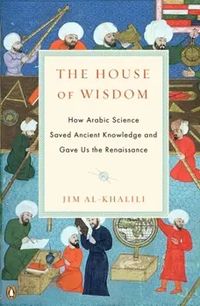
The House of Wisdom: How Arabic Science Saved Ancient Knowledge and Gave Us the Renaissance, by Jim Al-Khalili. (2012)
If the last time you read about the European Renaissance was high school, then much of the material in this book may come as a shock.
There was a glorious (and relatively brief) flowering of knowledge, research, science and ancient manuscript rescues and translations during a window of time between about 750 AD and 950 AD, under the Abbasid Caliphate, centered in Baghdad. That is the time when much of the philosophy, physics and other learned speculation from ancient Greece was rescued from oblivion. At the same time, many brilliant Persians, Christians and Jews joined in those efforts, to gather other major advances from China and India.
We see the birth of true scientific methodology, innovative number systems (like the so-called Arabic numerals) and decimal mathematics. Algebra was invented. Optics studied, and its rules defined. Solutions to the quadratic equation were demonstrated. Early methods in calculus were explored. Geolocation was dramatically improved. Massive libraries were built, and staffed with the finest scholars.
Like all "golden ages", this one burst onto the scene, then faded. Much of that work was transferred in subsequent centuries to the Muslim caliphates in Iberia (today's Spain)—al Andalus, from which it began to slowly seep into an intellectually dozing Europe, in the form of translations into Latin. That is, until the 13th century, when Christian forces eventually drove the Muslims out. That was the so-called reconquista.
The author has been a long-time science journalist for the BBC.
Bob