
Wombat_smokes
Well-Known Member
A brief case study of seedlings and nutrition:
This picture is of my 8 week old Trabzon (front) and Little Dutch (back) fall crop experiment. This is also 1 hour after watering a VERY thirsty tray of seedlings with their 1st dose of fertilizer: 1 teaspoon of 18-18-21 all purpose fertilizer in 1/2 gallon of water. The sister trays of Bitlis, Anatolian, Malatya, Shargo, Small Stalk Black Mammoth, and Åhus are equally anemic.
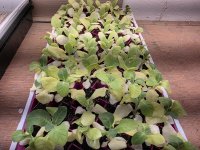
No leaf clipping, no fertilizers (until today). Some plants have decently green new growth while others are variegated (light green to mottled yellow). All plants have lower leaves that have yellowed or bleached out (chlorosis).
It is normal for older, lower leaves to die back as they become unnecessary for the plant's growth; however, this is not what is happening. These leaves are being "cannibalized" - nutrients taken from lower leaves to feed new growth in the absence of good nutrition.
I avoided fertilizers to prevent "explosive" growth prior to hardening them for transplant. I was also curious about the impact of leaf clipping. While my Åhus and this tray present modest root growth into the 1020 tray, it's nowhere near as prolific as my 1st crops that received occasional fertilizers and leaf clipping.
Conclusions:
While fertilizers with a good N-P-K rating are essential to healthy, robust plant growth; timing is equally important. Timing is not only what you feed and how often, but includes when you administer (esp. with respect to growth stage). My case study demonstrates a moderately extreme case of withholding nutrients to promote a rapid growth phase at time of outdoor acclimation and transplant.
I'm certain they will do well as they harden & transplant, but applying fertilizers closer to 4 weeks would provide stronger plants. The leaves would be vibrant green, plentiful & large enough to clip; and while an equally robust root system would develop. The more biomass above & below the soil at time of transplant guarantees the best survival and recovery rates from transplanting.
This picture is of my 8 week old Trabzon (front) and Little Dutch (back) fall crop experiment. This is also 1 hour after watering a VERY thirsty tray of seedlings with their 1st dose of fertilizer: 1 teaspoon of 18-18-21 all purpose fertilizer in 1/2 gallon of water. The sister trays of Bitlis, Anatolian, Malatya, Shargo, Small Stalk Black Mammoth, and Åhus are equally anemic.
No leaf clipping, no fertilizers (until today). Some plants have decently green new growth while others are variegated (light green to mottled yellow). All plants have lower leaves that have yellowed or bleached out (chlorosis).
It is normal for older, lower leaves to die back as they become unnecessary for the plant's growth; however, this is not what is happening. These leaves are being "cannibalized" - nutrients taken from lower leaves to feed new growth in the absence of good nutrition.
I avoided fertilizers to prevent "explosive" growth prior to hardening them for transplant. I was also curious about the impact of leaf clipping. While my Åhus and this tray present modest root growth into the 1020 tray, it's nowhere near as prolific as my 1st crops that received occasional fertilizers and leaf clipping.
Conclusions:
While fertilizers with a good N-P-K rating are essential to healthy, robust plant growth; timing is equally important. Timing is not only what you feed and how often, but includes when you administer (esp. with respect to growth stage). My case study demonstrates a moderately extreme case of withholding nutrients to promote a rapid growth phase at time of outdoor acclimation and transplant.
I'm certain they will do well as they harden & transplant, but applying fertilizers closer to 4 weeks would provide stronger plants. The leaves would be vibrant green, plentiful & large enough to clip; and while an equally robust root system would develop. The more biomass above & below the soil at time of transplant guarantees the best survival and recovery rates from transplanting.