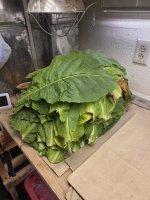
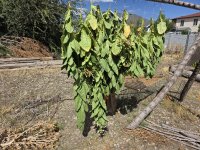
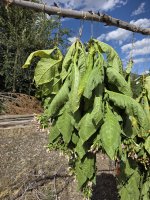
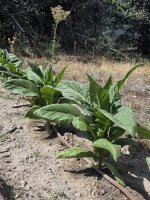
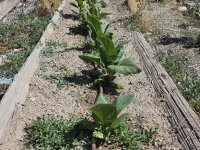
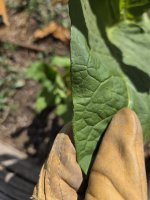
Here are a few more photos of samples I found while stacking my Frog Eye Orinoco this morning. I encountered these in the inner lamina as small circles, streaks, and dew drops.
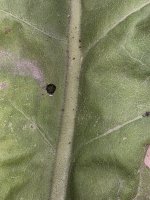
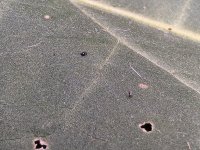
The two most "harmless" theories are vascular pest feeding and excess water in the plant.
Pest Theory: Vascular pests feed on tissues that transport nutrients rich "sap/water" through the plant. Such pests include aphids. The black substance is a) oxidised honeydew, or b) sap excreted from the puncture made by insects.
Excess Water Theory: tomato fruits often split when they receive excess water after the fruit has ended its growth stage. Much like humans and stretch marks (scaring of the skin from cutaneous fat deposits formed faster than the skin can stretch). In this case, the sap leaks out of the small, capillary like structures when they rupture. This may have happened from our recent monsoon rains and/or leaving the extra watering to help my plants cope with the 100 degree summer weather. Temps have since begun to drop and I've reduced the water to bare minimum.
Why is it black? Oxidation. When we make Cavendish, snus, or perique; the nicotine, resins, and oils oxidise to a black color.
The worst possible theory: early fungal rot. The sap from the aforementioned theories provides a tasty soup for fungi to grow. Also, insect frass (poop) can mix with rain water or humidity trapped between leaves and cause the rot.
Given the presence of the black substance on leaf tips and edges that receive full sun, I am in favor of the excess water theory. However, out of caution, I removed most of the affected lamina.
Here is my pilon of Frog Eye Orinoco